Key Takeaways
- Digital twins shift engineering from reactive to predictive decision-making
- The value compounds when twins are connected across product, process, and plant levels
- Simulation governance determines whether twin outputs are credible enough to act on
- Not every product needs a full digital twin—prioritize high-value, high-risk assets
Short Answer
A Digital Twin is a virtual representation of a physical product, process, or system that is continuously updated with real-world data—enabling engineers to simulate behavior, detect anomalies, and predict failures without physically touching the asset. Unlike a CAD model, a digital twin is dynamic: it evolves in lockstep with its physical counterpart throughout its operational life.
- A digital twin is a live, data-synchronized model—not a static CAD file
- Three primary types exist: product twins, process twins, and plant (system) twins
- IoT sensor data closes the loop between the physical asset and its virtual replica
- Digital twins enable predictive maintenance, which reduces unplanned downtime
- In PLM, digital twins extend product lifecycle management into operations and service
What Is a Digital Twin?
A digital twin is a virtual replica of a physical asset that stays synchronized with the real world.
Not a snapshot. Not a design model. A continuously updated simulation that reflects the current state of the physical thing it represents—its temperature, load, wear, usage history, and operational environment.
When a jet engine's bearing starts degrading, its digital twin shows the anomaly before the failure. The insight arrives before the damage does.
Digital Twin vs. CAD Model vs. Digital Thread
These three terms are frequently conflated. They are not the same.
| | CAD Model | Digital Thread | Digital Twin | |---|---|---|---| | What it contains | Design geometry and structure | Linked lifecycle data | Live operational state + simulation | | When updated | During design | At each lifecycle event | Continuously, in real time | | Who uses it | Design engineers | PLM, compliance, supply chain | Operations, maintenance, service | | AI-ready? | Partially | Yes, as data backbone | Yes, as predictive engine |
The Digital Thread is the data backbone connecting design to manufacturing to operations. The Digital Twin sits at the operational end of that thread—the live, simulation-enabled replica of the physical asset.
A CAD model answers "what was designed." A digital twin answers "what is happening right now."
Types of Digital Twins
Not all digital twins are the same. The field recognizes three primary types.
Product Twin
A product twin represents a specific physical unit—one particular manufactured instance of a product.
It receives telemetry from that specific unit's sensors: temperature, vibration, load cycles, error codes. It runs physics-based simulations with real-time inputs to project remaining useful life and detect anomalies.
Product twins are most mature in aerospace, energy (turbines, compressors), and industrial equipment.
Process Twin
A process twin models a manufacturing or operational process—not a physical product, but the workflow that produces or operates products.
It monitors throughput, cycle time, quality metrics, and resource utilization. Engineers use it to identify bottlenecks and simulate changes before implementation.
Plant (System) Twin
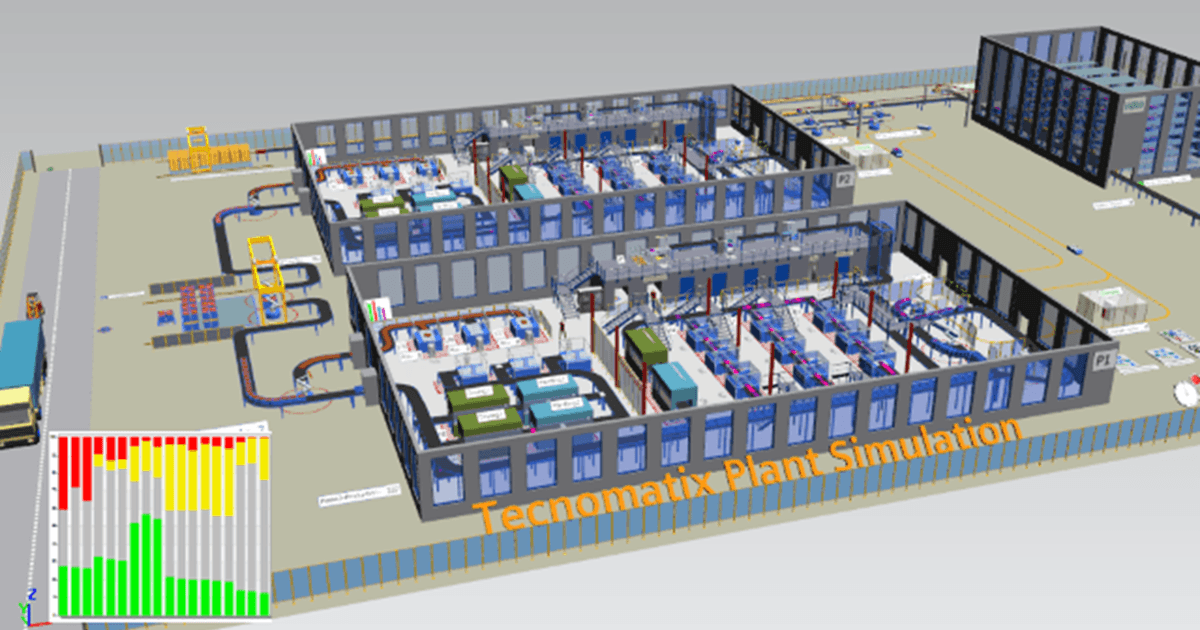
A plant twin is a digital model of an entire facility or system of systems.
It aggregates data from process twins and product twins to give a facility-level view of performance, energy use, and capacity.
Advanced implementations nest all three: plant twins aggregate process twins, which reference product twins—creating a hierarchy of synchronized models.
The IoT Connection
A digital twin without live data is just a simulation model. Industrial IoT is what makes it a twin.
Industrial IoT sensors embedded in physical equipment stream real-time measurements—temperature, pressure, vibration, electrical load, flow rate—to the twin's data synchronization layer. That layer maps sensor signals to model parameters, keeping the simulation current.
The fidelity of the twin depends on sensor coverage and data quality. A twin receiving five sensor signals behaves very differently from one receiving five hundred. Instrumentation strategy is a foundational design decision.
Digital Twins in PLM
In the PLM context, digital twins close the product lifecycle loop.
Traditional PLM stops at delivery. The product ships, and PLM's role in its life effectively ends—replaced by service systems that rarely talk back to the product's design record.
A digital twin changes this. Field performance data flows back through the twin to PLM systems, informing next-generation design decisions. A failure pattern seen in the field appears as a data signal traceable back to a specific design choice in the Digital Thread.
The Bill of Materials for a specific delivered unit—the "as-maintained" BOM—is kept current by the twin as parts are replaced and configurations change.
Simulation Governance: The Overlooked Requirement
A digital twin is only as trustworthy as the simulation model underlying it.
If the physics model has not been validated against real-world behavior, the twin will give wrong answers with high confidence. In safety-critical applications—aerospace maintenance, medical device monitoring, energy infrastructure—a wrong answer is dangerous.
Simulation governance prevents this. It encompasses:
- Verification: confirming the model is implemented correctly (the math is right)
- Validation: confirming the model represents physical reality (the physics is right)
- Credibility assessment: defining conditions under which the twin's outputs are fit for use
- Audit trail: recording which model version was used for each decision
Organizations deploying digital twins without formal simulation governance are accumulating technical risk they may not discover until a high-stakes decision goes wrong.
Predictive Maintenance: The Primary Business Case
For most manufacturers, predictive maintenance is the clearest ROI driver for digital twin investment.
The cost of unplanned downtime in capital-intensive industries dwarfs the cost of the digital twin infrastructure required to prevent it.
A product twin running with real-time sensor data and a validated degradation model can forecast component failure weeks in advance. Maintenance is scheduled at a convenient time. The failure that would have shut the line for three days becomes a planned four-hour service window.
The shift is from time-based maintenance (change the filter every 1,000 hours) to condition-based maintenance (change the filter when the twin indicates it is 85% degraded). This eliminates both unnecessary preventive maintenance and catastrophic reactive maintenance.
Where to Start
Not every product needs a full digital twin. The investment is significant.
Prioritize based on asset criticality (high-consequence failure modes justify twin investment), sensor accessibility (already-instrumented assets are easier to twin), data availability (field data programs and service records feed twin training), and model maturity (products with validated simulation models have a head start).
Most successful implementations start with one high-value asset class and expand from there as data infrastructure and governance processes mature.
Summary
A digital twin is a live virtual replica of a physical asset, synchronized with real-world data to enable monitoring, simulation, and prediction.
It differs from a CAD model (static) and a Digital Thread (data backbone) in that it is dynamic, operational, and simulation-driven. The primary business case is predictive maintenance. The critical success factors are IoT data fidelity, validated simulation models, and simulation governance.
In PLM, digital twins close the lifecycle loop—bringing field performance back into the design record to drive continuous product improvement.
Related reading:
Want to listen instead of read? 56 DemystifyingPLM articles are available as audio.
Browse audio →Looking up PLM terminology? Browse the canonical reference.
PLM Glossary →Cite this article
Finocchiaro, Michael. “What is a Digital Twin?.” DemystifyingPLM, May 10, 2026, https://www.demystifyingplm.com/what-is-digital-twin
PLM industry analyst · 35+ years at IBM, HP, PTC, Dassault Systèmes
Firsthand knowledge of the evolution from early 3D modeling kernels to today's cloud-native platforms and agentic AI — the history, strategy, and future of PLM.